The short answer
Most Texas dumpster rentals need no permit at all, because the container sits on private property: a driveway, a job-site lot or a business parking area with the owner's permission. Permission becomes a question when the container goes onto public right-of-way, meaning the street, an alley, a sidewalk or the strip between sidewalk and curb. Who controls that ground decides who you ask. On top of that, an HOA or deed restriction may control what you can do on your own driveway.
Step 1: where will the container sit?
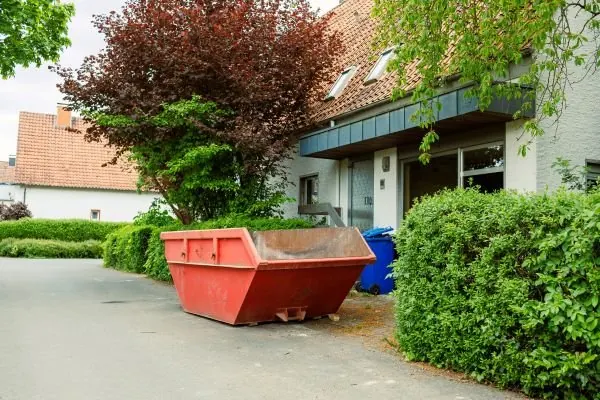
On your driveway or lot
This is the simplest case. Most cities do not require a permit for a container on private property. You still need to think about:
- HOA rules and deed restrictions. Many Texas subdivisions limit how long a container may stay, require approval, or set placement rules.
- Fire lanes and access. On commercial property, keep containers out of fire lanes, accessible parking and drive aisles.
- The surface. Use boards under the rails; most rental agreements make you responsible for driveway damage.
In the street or alley
Streets and alleys are public right-of-way. Inside a city, the city usually controls them; in unincorporated areas, the county does; on state highways and frontage roads, the Texas Department of Transportation does. Many Texas cities require permission to place an object such as a dumpster in the right-of-way, sometimes with conditions such as reflectors, barricades, distance from intersections and a time limit. Check with the city's public works, transportation or right-of-way office before the drop day.
On a sidewalk or parkway
Blocking a sidewalk raises accessibility and safety issues, and cities are generally strict about it. Avoid it unless the city has explicitly approved the placement.
Step 2: find the right office
Search the city's website for "right-of-way permit", "street use permit" or "obstruction permit", or call the city's general information line and ask which department handles containers in the street. Examples of who to ask in our larger cities:
- Houston: Houston Public Works.
- Dallas: the City of Dallas, which regulates objects in streets and alleys.
- Austin: Austin Transportation and Public Works.
- San Antonio: the City of San Antonio's right-of-way staff.
For unincorporated areas, call the county. Outside city limits in places like Katy, The Woodlands, West Odessa or Gardendale, the county may maintain the road. For the road in front of a business on a state highway, TxDOT may control the right-of-way.
We do not list ordinance numbers, fees or time limits, because they change and differ between cities. Typical national permit-fee ranges, with their source, are on our pricing page. The city's own office is the only reliable source for your address.
Step 3: check the HOA
Texas has a large share of homes in HOA-governed communities, especially in the suburbs around Houston, Dallas-Fort Worth and Austin. Common HOA rules on containers include:
- A maximum number of days.
- Approval or notice before placement.
- Driveway only, never the street.
- Covering or screening the container.
- Restrictions on weekend or holiday placement.
Read the deed restrictions or design guidelines, or call the management company. If approval is needed, get it before booking.
Step 4: special districts
Some areas have extra layers:
- Historic districts. In cities such as San Antonio, Fort Worth, McKinney and Georgetown, demolition and exterior changes in historic districts usually need review. The dumpster itself is rarely the issue, but the work it supports may be.
- Tree protection. Austin and some other cities protect larger trees. Keep containers and trucks off root zones.
- Recycling ordinances. Austin's construction and demolition recycling ordinance requires larger permitted projects to divert waste from landfill.
- Environmental areas. Over the Edwards Aquifer recharge zone around San Antonio and Austin, regulated development has extra state requirements.
Common placement scenarios
A townhome with a shared drive. The drive may be common property controlled by the association, not by you. Get written permission from the association and agree with neighbors on timing, because a container may block their garages.
A corner lot. A container near an intersection can block sight lines for drivers. Even where the street is allowed, cities often require a set distance from corners. The driveway or side yard is usually the better spot.
A business in a strip center. The parking lot belongs to the property owner. Get the landlord's written approval of the exact spot, keep fire lanes and accessible spaces clear, and schedule swaps outside busy hours.
A new-build lot. On your own lot, no city permit is usually needed for the container itself. The builder's HOA rules, erosion-control requirements and site plan still apply, and the truck should not cross sidewalks or curbs that the city has just accepted.
A rural property. Outside city limits, the county maintains most roads. Keep the container off the road surface and out of the bar ditch, which carries runoff in heavy rain.
Step 5: confirm with the provider
When you book, ask:
- Do you handle street permits, or do I?
- Do you supply cones, reflectors or barricades if the city requires them?
- What happens if the city or HOA asks for the container to move?
- Is there a fee to relocate it?
Write down the answers. Then call (512) 859-6546, and we will line up a provider that knows the rules where you are. For local notes, see our city pages, starting with Houston, Dallas and Austin.